
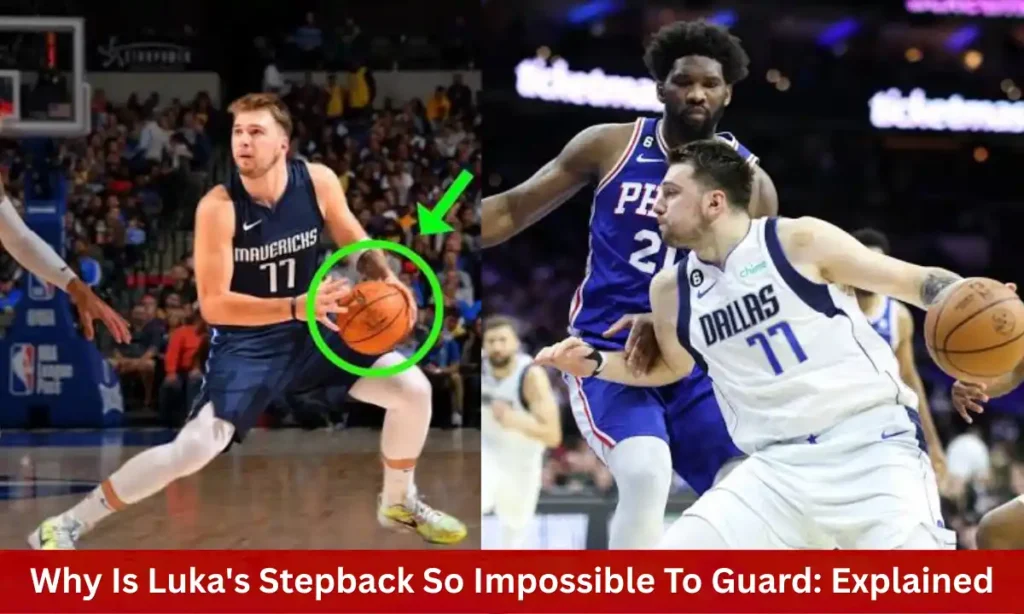
Luka Doncic’s stepback move has earned its place among the best moves in basketball today. The defense prepares for the move, the coach plans against it, and the opponent positions to avoid it. However, even when it is known that Doncic is going to perform the stepback move, blocking his shot proves to be nearly impossible.
There is more than just the fact that Luka Doncic is a great shooter behind his stepback success.
What makes his move special is the combination of many factors which make him react to defenders’ moves and make the latter unable to predict what is going to happen next.
First, the defender might think that Luka Doncic is going to drive to the basket. Instead, Luka slows down.
Now the defender has to try to recover.
Luka changes his direction.
Once again, the defender tries to get in front of him.
However, now Luka creates some distance.
And finally, he steps back and releases the shot right away.
Thus, the space becomes too big to cover for the defender even by the time he reacts to the move.
This article describes why is luka’s stepback so impossible to guard, how this move works, what makes Luka’s version of it different from a regular stepback and why it is so difficult even for the elite defenders of the NBA to stop it.
Who Is Luka Doncic?
Luka Doncic is a professional Slovenian basketball player who became one of the most influential players in offensive basketball of his generation.
While growing up in Europe before his NBA career began, Luka got an unusual level of understanding of many basketball aspects such as pace, angles, pick-and-roll basketball, footwork, and reading defenders.
Doncic joined the NBA in 2018, having been drafted by the Atlanta Hawks as the third pick in the draft. He immediately showed great results as a young player.
Luka became known as one of the most prolific scorers and playmakers.
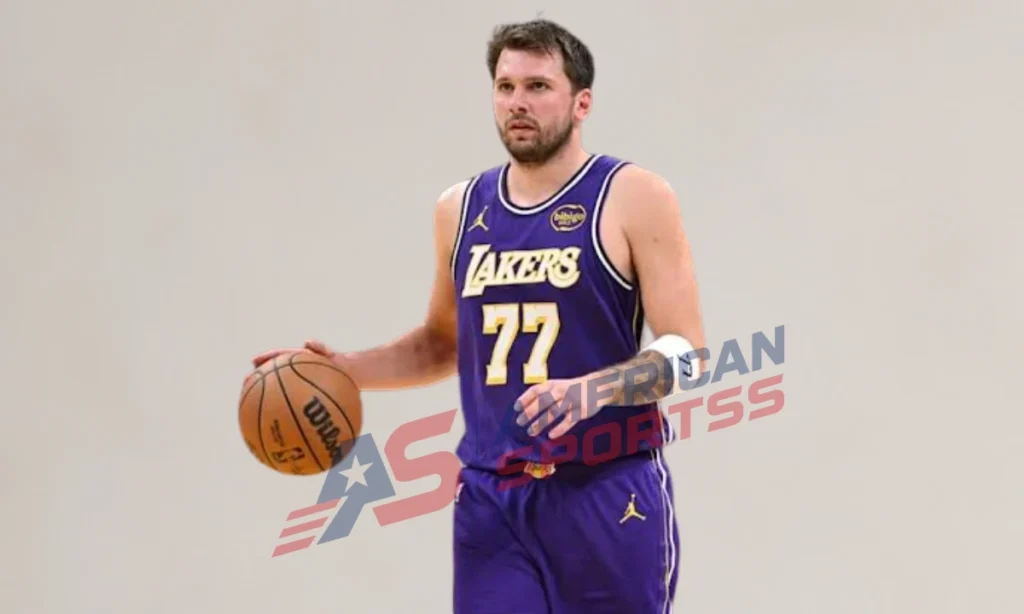
Among the skills of Luka’s offensive game are:
- Stepback three-pointers
- Pull-up jumpers
- Post-ups
- Pick-and-roll creation
- Floaters
- Around-the-basket finishing
- Change of pace drives
- Step-through moves
- Passing from unusual angles
- Mismatch hunting
Among all these moves, his stepback became one of his main scoring plays.
What Is Luka Doncic’s Stepback?
Stepback is a ball-handling technique that allows an offensive player to increase the distance from a defender by stepping backwards prior to shooting the basketball.
In principle, the technique looks pretty straightforward:
Go to attack → force the reaction → step back → create separation → shoot.
However, its execution is rather complicated.
Firstly, an offensive player must possess enough balance to stop his forward movement, enough control to move backwards and enough shooting skills to be able to score after performing such a move.
What makes the stepback even more challenging for defenders to guard Luka Doncic is the fact that he performs it at a variety of speeds and paces.
The move can include slow advance, sudden acceleration, hesitation, crossovers, ball protection with his body, directional changes, and finally – separation.
Therefore, a defender does not simply need to guard a stepback move.
He has to predict what Luka’s next action will be after each separate phase of the technique.
Why Is Luka’s Stepback So Impossible To Guard?
There is not just one reason behind this phenomenon.
It is all about several advantages of the move being performed simultaneously.
1. Luka’s Height Becomes a Big Plus
Doncic is 6 feet 6 inches tall.
This is quite a significant factor.
Whereas other players need considerable separation in order to get a nice shot off over a defender, Luka does not always have to create such a distance.
As soon as he moves backwards, Doncic becomes taller than his defender in many cases.
Moreover, he may rely on his height and high shot release to effectively use his body in order to protect the shot from any kind of contest by the defender.
2. Luka Uses Pace Instead of Constant Speed
Another secret behind Doncic’s game is his ability to control the pace of the play.
Many offensive players depend on the pace.
However, Luka often does the opposite.
- He reduces the pace of the game.
- He walks through possessions.
- He stops.
- He paces himself.
- He waits for the defender to do something.
- Then he acts.
This makes the defender face the issue of timing.
Defenders are expected to respond to the actions of the offensive player, but Luka regularly changes his pace without altering the direction.
Slow move can be turned into the attack.
Attack can be suddenly turned into the stop.
Stop can be transformed into the stepback.
Therefore, the defender should be prepared for all these options.
3. His Stepback Begins Before the Stepback
- It is one of the most important aspects that allow Luka to succeed.
- The step itself does not beat the defender in most cases.
- The actions taken prior to the actual step often create the separation from the defender.
- Suppose Luka approaches the defender using dribble.
- The defender should respect the possibility of the drive to the basket.
- In case the defender moves back to protect the area around the basket, Luka has enough room for shooting.
- If the defender attempts to block the shot by moving forward, Luka has enough space to move past the defender.
- This makes Luka to use the position of the defender against him.
- Stepback is thus the last phase of the sequence of the moves.
4. Defenders Should Respect Luka’s Drive
It is very important aspect that makes Luka’s move difficult to defend.
- Stepback becomes significantly easier when the defender knows that the offensive player cannot beat him using the drive to the basket.
- However, Doncic can drive the ball on both sides.
- He can generate physical contact with the defender.
- He can stop and change directions.
- Moreover, Luka can score points after such actions.
- Defender has to respect this skill and be ready for the drive, which allows Luka to take advantage of the stepback.
5. Luka’s Change of Direction Is Hard to Predict
Luka Doncic does not use complicated crossovers to beat the defenders.
- However, he uses a lot of other techniques.
- For instance, he shifts his body.
- He alters his dribble pattern.
- He uses the hesitation.
- He leans on one side.
- He tries to convince the defender that he is going to attack.
- These subtle moves can make the defender to shift his weight.
In case the defender shifts in the wrong direction, Luka gets the opening.
That is why slow-motion footage makes this move look simple and defending it in real-time becomes significantly more complicated.
6. His Balance Is Exceptional
- A good stepback move needs exceptional balance.
- The player needs to run forward, stop, run backwards, and switch into shooting.
- All that sequence of actions can ruin shooting mechanics.
- However, the ability of the young player to shoot after separating from defenders is quite unusual.
- Because of his skills and body control, it becomes easier to perform a difficult jump shot.
- Thus, it does not matter if he is not completely static when switching into shooting position.
- It gives him another advantage.
7. Luka’s Footwork Is a Significant Part of the Move
However, it is important not just to jump backward.
Placement of feet is crucial.
- Balance is crucial.
- Timing is crucial.
- Position of the body is crucial.
- Mechanics can vary depending on the situation but Luka’s footwork allows him to separate himself from the defender and maintain some control over his body at the same time.
- It is especially useful when the young player operates in isolation.
- The defender tries to stay with Luka, while Luka tries to create some room between the defender and himself.
Those inches can define how contested the shot will be.
8. His Strength Makes the Stepback Harder
- Luka Doncic is not only tall but also strong.
- It is important because it is not easy for the defender to bump him out of his line.
- When Luka protects the ball with his body, the defender needs to make a difficult decision.
- Excessive contact with the young star results in foul.
- Otherwise, he can keep his advantage.
- Strength helps the young player to stop and change the direction of movement without being displaced.
9. Luka Is Comfortable Shooting From Deep
- Another important thing that makes his stepback move so effective is the shooting range of Luka.
- If it would not be so wide, the defenders can try to push him away.
- However, Doncic is able to shoot from deep positions on the field.
- Thus, the defender cannot afford just some extra distance from him.
10. The Defender Has No Margin for Error
- Imagine a defender defending Luka on the perimeter.
- If the defender stands too close to the player, he can drive.
- If the defender stands too far, Luka takes a shot.
- If the defender reaches out for the ball, Luka uses the momentum of the defender.
- If the defender turns his hips too early, Luka changes direction.
- If the defender stays square, Luka uses his strength and speed to attack.
- It makes a really difficult defensive situation for the defender.
- The defender is constantly trying to choose the least damaging option.
- Luka’s skill is finding the weakness in whichever option the defender chooses.
The Stepback Is Really a Decision-Making Battle
One could easily think that Luka’s stepback is some kind of footwork trick.
However, that description is not entirely accurate.
Ultimately, it is a decision-making tool.
Luka is analyzing the opponent.
He analyzes:
- Feet of the defender
- Position of hips
- Distance between the defender and Luka
- Weight distribution of the defender
- Angle of the defense
- Presence of the help defense
- Condition of shot clock
- Coverage of pick-and-roll
- And then he chooses his approach.
That is the reason why Luka can execute dribbling moves similarly but get different results.
He is not doing some memorized tricks.
He is acting based on the information that he gets from the defender.
Comparison of Luka’s Stepback with a Regular Stepback
Typically, a regular stepback looks like that:
- Try to attack the defender
- Get a little bit of forward momentum
- Push yourself backwards
- Create some space
- Shoot
However, Luka’s stepback is much more complex.
The possession may look like that:
- Slow dribble
- Hesitation
- Shift of the defender
- Directional change
- Attack
- Retreat of the defender
- Quick stop
- Stepback
- Shot
In other words, each element of his possession forces the defender to make a decision.
Thus, the final stepback is supported by many small advantages.
Why Is Luka’s Stepback So Slow But Still Efficient?
It is one of the most intriguing aspects of his game.
Luka is not always explosive.
He is even sometimes very casual looking.
However, explosiveness in basketball does not mean maximum speed.
Sometimes change of speed becomes more effective than the maximum speed.
In case the defender moves at one certain speed and the attacker changes it suddenly, the defender may lose the balance.
Here is how it works for Luka:
- Slow movement towards the defender
- A little bit of accelerating
- Reaction of the defender
- Decelerating
- Defender adjusts
- Attack/Stepback
This repeated acceleration and deceleration makes his movements difficult to predict.
The Importance of the Defender’s Center of Gravity
Basketball defense depends heavily on balance.
A defender wants to keep their weight centered so they can react in either direction.
But an offensive player is constantly trying to move that balance.
Luka is exceptionally good at doing this.
He uses hesitation dribbles, shoulder movements, changes of direction, and pace changes to make defenders shift their weight.
Once a defender’s center of gravity moves too far toward one direction, Luka can attack the opposite space.
This is one reason his stepback can look effortless.
The defender may already be beaten before Luka actually moves backward.
Luka’s Stepback and the Pick-and-Roll
Doncic’s stepback becomes even more dangerous when combined with the pick-and-roll.
The screen forces the defender to make a decision.
The defender might:
- Fight over the screen.
- Go under the screen.
- Switch.
- Hedge.
- Drop.
- Blitz.
Each defensive choice creates different possibilities.
If the defender goes under, Luka may have space for a jumper.
If the defender fights over, Luka can attack.
If the defense switches, Luka can hunt a larger or slower defender.
If the big man drops too far back, Luka can shoot.
This means his stepback is not an isolated move.
It fits naturally into his larger offensive system.
Why Bigger Defenders Also Struggle Against Luka
One might think the obvious solution is to put a larger defender on him.
But bigger defenders often have another problem.
They can struggle to stay in front of Luka’s changes of pace and direction.
Luka can deliberately attack slower defenders.
He can bring them into space.
He can use a screen.
Then he can force them to move backward.
Once the defender is uncomfortable, Luka can create separation for the stepback.
The size advantage of the defender can therefore become less important if the defender cannot move quickly enough.
Why Smaller Defenders Have Their Own Problem
Smaller defenders have the opposite issue.
They may have excellent lateral quickness, but Luka can use his height and strength against them.
- He can post them up.
- He can shoot over them.
- He can create contact.
- He can use his body to shield the ball.
- And he can still step back for a jumper.
- So the defense faces a difficult matchup problem.
There may be no perfect individual defender.
Luka’s Shot Creation Is More Important Than Raw Shooting Percentage
However, what matters is not just how often Luka hits stepback shots.
Their strategic value is much higher.
Because of the fear of the stepback, the defender has to change their positioning.
That change opens driving lanes.
If Luka gets extra space, he can score from there.
If the defender is aggressive and closes out to Luka, he can beat him with a drive.
Hence, the stepback changes the whole defensive strategy of the opponent.
The Stepback Leads to “Defender’s Dilemma”
Let us consider a simple example.
Luka has the ball near the three-point line.
The defender thinks:
“If I don’t stop the drive, it will lead to an easy layup.”
So the defender goes back.
Luka scores from outside.
If the defender thinks instead:
“If I don’t contest the jumper, Luka will make it easily.”
The defender will close out quickly.
Luka goes to the basket.
Or if the defender tries to find the middle ground, then Luka takes the hesitation step.
The defender shifts to react.
Then Luka uses the stepback move.
It is the main dilemma that the defender faces.
There is no optimal positioning here.
Luka’s offense skills enable him to punish the defender for different decisions.
Why Luka Does Not Need a Big Stepback
Another mistake that people make is that the greatest stepback should create a huge separation from the defender.
However, it is not always the case.
Sometimes it is enough to get a tiny bit of space between you and the defender and remain balanced to shoot.
Because of Luka’s height and his release point, this slight separation becomes critical.
This is why sometimes his stepback looks absolutely average.
The separation does not need to be huge.
It only has to be enough for a good shot.
Luka’s Ability to Rise Over Defenders’ Contests
The defender does not have to be beaten to let Luka shoot the ball.
Thanks to Luka’s size and shooting technique, he can sometimes rise over a contesting defender.
It adds additional dimension to Luka’s offense.
The defender might correctly predict when Luka will use a stepback move.
They might shift back at the perfect moment.
However, if Luka has enough separation to raise above the defender, he will still be able to shoot.
The Mental Side of Luka’s Stepback
Elite basketball is a combination of physical and mental skills.
Luka realizes that the opponent knows about his stepback.
- It is already a known fact.
- The opponent may go under the ball in an attempt to prevent a three-point shot because they fear that shot.
- Luka recognizes it.
- He can attack the opponent’s front foot.
- Drive.
- Create a foul.
- Pass to a teammate.
As a result, the reputation of his stepback adds to the effectiveness of the move.
The opponent is not reacting to his present actions.
The opponent reacts to the possibility of those actions.
Why Luka’s Stepback Differs From Stephen Curry’s Stepback
Luka and Stephen Curry both use stepbacks and hard-to-defend pull-up jumpers, but their styles differ significantly.
While Curry relies mostly on:
- Speed
- Fast release
- Constant motion
- Range
- Off-ball motion
- Changes of direction
- Luka depends on:
- Size
- Strength
- Pace
- Hesitation
- Body positioning
- Pick-and-roll manipulation
- Isolation plays
- Changes of pace
Both styles are very hard to defend, but in different ways.
Curry can overwhelm the opponent with motion, while Luka overwhelms the opponent with control and manipulation.
Why It Is Hard to Teach Luka’s Stepback
A basketball player can learn how to perform the stepback itself.
However, it is hard to teach the player how to do it in Luka’s manner.
The player would need to have:
- Elite balance
- Excellent control of the lower body
- Good ball handling skills
- Ability to shoot from various distances
- Body positioning skills
- Excellent timing
- Patience
- Skills of defensive reading
- Ability to change the pace of movement
- Confidence
Most importantly, a player should learn when to use a stepback.
Even if the move is performed perfectly technically, but done in the wrong moment, it will be a poor basketball play.
Luka’s effectiveness partly comes from his ability to understand when the defender is vulnerable.
Why Luka’s Movement Is So Effective
There is one more thing why Luka’s movement is so useful.
Luka rarely seems to waste his energy.
He does not need to run across the court in order to gain some kind of an advantage.
Instead, he often uses small movements.
- A hesitation.
- Shoulder fake.
- Short dribble.
- Change of direction.
- Sudden stop.
They are effective because they force the opponent to move more than Luka needs to.
Thus, there is one more principle:
- Sometimes the most effective offensive movement is the one which makes the defender spend more energy than the offensive player.
- Luka is especially skilled in it.
- The Use of Body Positioning Skills
- Luka often uses his body positioning as the part of ball protection.
- During driving to the basket, he can put himself between the defender and the ball.
- Thus, it is risky to try to steal the ball because it forces the defender to keep discipline.
This way, Luka keeps control of the ball and decides whether to:
- Continue the drive.
- Stop.
- Pass the ball.
- Shoot.
- Step back.
Body positioning gives him additional time for decision making.
Why Luka’s Stepback Is Particularly Dangerous When the Shot Clock Runs Out
When there is little time left until the end of the possession, the opponents expect the primary scorer to create a scoring opportunity.
- It can work to Luka’s advantage.
- He does not need a complex play.
- He can isolate himself.
- Get a screen.
- Attack the basket.
- Step back.
- Shoot.
As he has many possibilities to create a scoring chance, the opponents cannot close all the openings.
Luka’s Stepback and the Three-Point Revolution
Modern basketball has placed enormous importance on three-point shooting.
- That makes Luka’s stepback particularly valuable.
- A traditional isolation jumper from midrange can produce two points.
- A successful stepback three produces three.
- At the same time, the threat of the three-point shot forces defenders to stay farther away.
- That creates more space for driving.
- Luka therefore benefits from the relationship between shooting and driving.
- His shooting creates driving opportunities.
- His driving creates shooting opportunities.
- The two skills reinforce each other.
Why Defenders Cannot Simply Double-Team Luka
If one defender cannot stop him, doubling might seem like the obvious solution.
But Luka is also an elite passer.
A double team can create an open teammate.
Doncic’s passing ability forces defenses to consider the consequences of sending an additional defender.
That is another reason his stepback is difficult to eliminate.
The defense cannot simply overload him without giving something else away.
The Stepback Is a Result of Luka’s Entire Offensive Package
It would be a mistake to view the stepback as an isolated trick.
It works because Luka has a complete offensive arsenal.
His:
Driving → creates shooting opportunities
His:
Shooting → creates driving opportunities
His:
Passing → punishes double teams
His:
Strength → creates physical advantages
His:
Size → makes contests more difficult
His:
Footwork → creates separation
His:
Pace → disrupts defensive timing
All of these elements connect.
The stepback is one part of a much larger system.
Why Young Players Should Not Simply Copy Luka’s Stepback
Luka’s stepback is spectacular, but young basketball players should understand that copying the move without learning its foundations can lead to poor habits.
Before attempting advanced stepbacks, players should develop:
- Proper shooting mechanics.
- Strong dribbling fundamentals.
- Balance.
- Footwork.
- Body control.
- Change-of-speed ability.
- Awareness of defensive positioning.
- Understanding of when to attack.
The goal should not be to imitate Luka’s exact movement.
The goal should be to understand why the movement works.
A Simple Breakdown of Luka’s Stepback
At a basic level, Luka’s stepback can be understood as a sequence of decisions.
Step 1: Establish the Threat
Luka approaches the defender while maintaining the possibility of a drive.
Step 2: Read the Defender
He watches the defender’s feet, hips, and positioning.
Step 3: Manipulate the Defender
He uses pace, hesitation, or direction changes to influence the defender’s movement.
Step 4: Attack the Space
He begins moving forward or sideways.
Step 5: Stop the Momentum
Luka creates enough control to transition from attacking forward to moving backward.
Step 6: Create Separation
The backward movement gives him the space needed to shoot.
Step 7: Rise and Release
He uses his height, balance, and shooting mechanics to complete the jumper.
Step 8: Punish the Defense
If the defender overreacts to the stepback, Luka can instead attack the basket or make a pass.
That final point is critical.
The defender is not merely guarding a shot.
They are guarding multiple possible outcomes.
What Makes Luka’s Stepback So Unique?
Several characteristics separate Luka’s version from an ordinary stepback.
Size
At around 6’6″, Luka has unusual height for a primary ball handler.
Strength
His physical strength helps him maintain control through contact.
Pace
He changes speed constantly.
Footwork
His balance and coordination allow him to transition smoothly from drive to shot.
Range
He can shoot from well beyond the three-point line.
Deception
He frequently makes the defender believe he is going somewhere before changing direction.
Patience
He does not rush possessions.
Basketball IQ
He reads the defense before committing to the move.
Together, these qualities make the stepback extraordinarily difficult to defend.
Frequently Asked Questions: Why Is Luka’s Stepback So Impossible To Guard
Why is Luka Doncic’s stepback so hard to guard?
Luka’s stepback is difficult because it combines his size, strength, shooting range, balance, footwork, change of pace, and ability to attack the basket. Defenders must respect both the drive and the jumper, which makes it difficult to predict his next action.
Is Luka’s stepback a travel?
A properly executed stepback is legal when the player follows the NBA’s rules governing gathering the ball and establishing legal steps. Luka’s unusual footwork has sometimes generated debate among fans, but not every unconventional-looking stepback is a traveling violation.
Does Luka use the stepback mainly for three-pointers?
The three-point stepback is one of his signature shots, but the broader concept is shot creation. He can also use similar movements to create midrange opportunities or set up drives.
Why doesn’t the defender simply stay farther away?
If the defender gives Luka too much room, he can shoot. If the defender moves closer to stop the shot, Luka can attack the space behind them. His driving ability makes simply backing off an unreliable solution.
Is Luka the best stepback shooter in basketball?
That depends on how “best” is defined. Luka is certainly one of the NBA’s most recognizable and effective stepback shot creators. Players such as James Harden, Stephen Curry, Damian Lillard, and others have also developed highly effective separation moves.
Does Luka need to be fast for the stepback to work?
No. In fact, one of the fascinating aspects of his game is that he often relies more on changes of pace than pure speed. His ability to slow down, accelerate, stop, and change direction can be more valuable than simply running past defenders.
What is the biggest secret behind Luka’s stepback?
The biggest secret is that the backward step itself is only the final part of the move. Luka first manipulates the defender through pace, positioning, ball handling, and the threat of driving. Once the defender reacts, the stepback becomes much easier to execute.
Final Verdict: Why Is Luka’s Stepback So Impossible To Guard
Luka Doncic’s stepback is not impossible to guard because of one magical movement.
It is difficult because everything that happens before the shot makes the final shot harder to defend.
- His height allows him to shoot over defenders.
- His strength allows him to maintain control.
- His ball handling allows him to attack from different angles.
- His pace changes the defender’s timing.
- His footwork creates separation.
- His shooting range punishes defenders who give him space.
- His driving ability punishes defenders who close out too aggressively.
- His passing ability punishes double teams.
- And his basketball intelligence allows him to recognize which option the defense is giving him.
That is what makes Luka’s stepback special.
The defender is not simply trying to stop a backward jump shot.
The defender is trying to survive a sequence of decisions in which almost every mistake creates an opportunity for Doncic.
- Give Luka space, and he shoots.
- Close the space, and he drives.
- Send help, and he passes.
- Play too aggressively, and he uses your momentum against you.
That is why his stepback has become one of the most feared moves in modern basketball.
The genius of Luka Doncic is not simply that he can step backward and make a difficult shot.
It is that he can make the defender believe there is a correct way to stop him—and then punish that decision.
Also, Read: Anthony Edwards Kids | “I’m Back” Michael Jordan | Jokic Brothers | Mac McClung Net Worth | Victor Wembanyama Height at 14 | Rachel Nichols and Jimmy Butler